WASH in Afghanistan: Trends and Challenges
/ 4 min read
Author: Tatara Wardag
Safe drinking water, sanitation and hygiene (WASH) are crucial for maintaining good health and wellbeing. In Afghanistan, a country recovering from decades of conflict and political turmoil, delivering essential services such as safe drinking water, sanitation, and healthcare has been particularly challenging. Nevertheless, progress in infrastructure and essential services has been associated with improvements in public health outcomes, economic participation, and overall wellbeing. This commentary examines trends in water and sanitation services and their importance for public health in Afghanistan.
Water Access in Afghanistan
In Afghanistan, climate change poses an ongoing threat to water access through recurrent droughts and changing precipitation patterns. A record number of droughts have reportedly forced families to leave their homes in search of water for basic needs such as drinking, cooking, and bathing.1
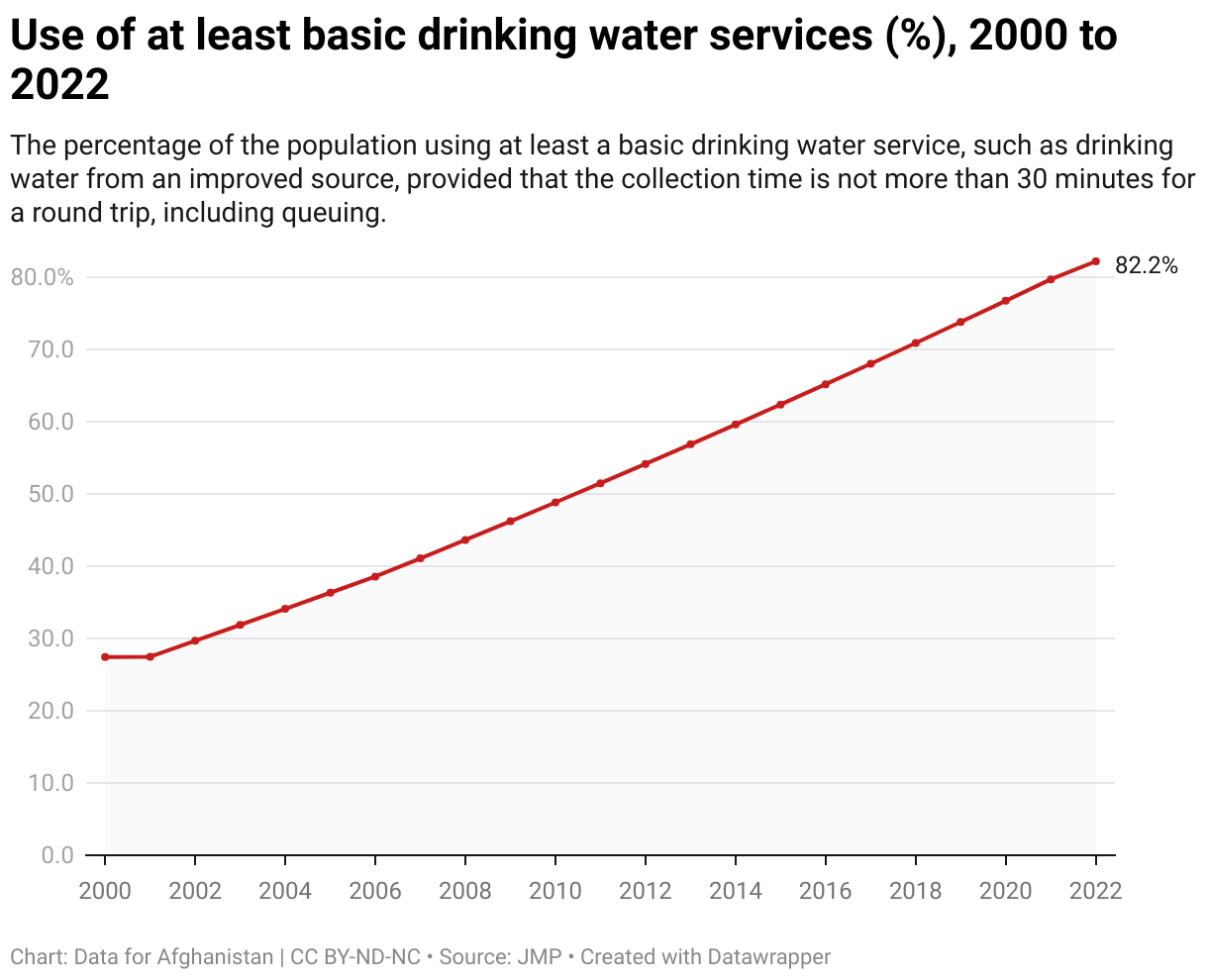
Figure 1 shows that between 2000 and 2022, access to basic drinking water services increased by 54.78 percentage points, reaching 82.2% in 2022, the highest level in two decades. This substantial increase reflects sustained efforts by international partners and local institutions to expand drinking water infrastructure and services. Expanded access to water is likely to have contributed to improvements in living conditions and reduced exposure to water-related health risks. However, despite these gains, water scarcity intensified in 2024, with 23% of households reportedly experiencing insufficient water for hygiene purposes.2 Ongoing pressure on water availability may also constrain progress in related areas such as sanitation and hygiene, where improvements have not advanced at the same pace.
Figure 1
Sanitation and Hygiene
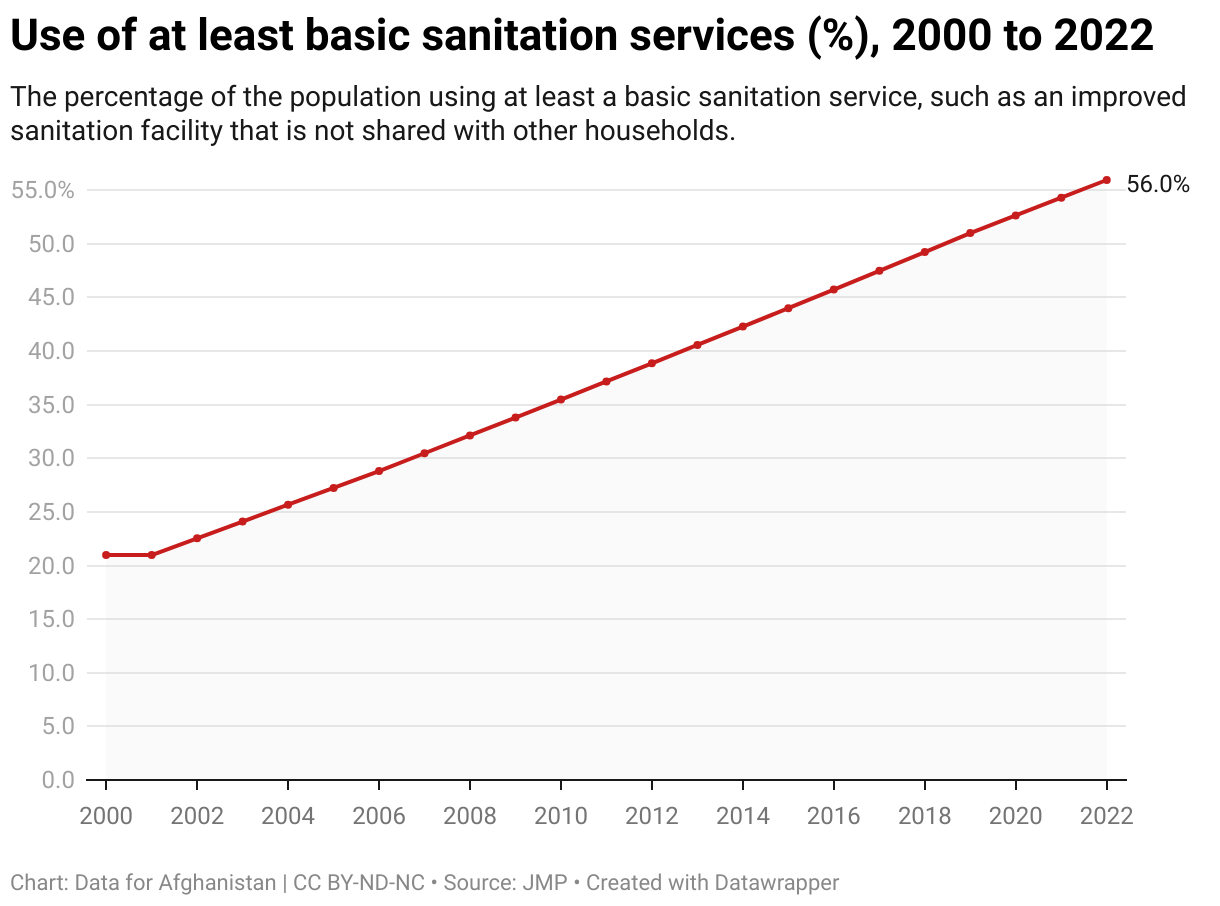
Sanitation and hygiene are fundamental to public health and human development. Effective sanitation can reduce the risk of disease transmission and is closely associated with educational attainment, economic productivity, and overall wellbeing. In 2000, approximately 21% of Afghanistan’s population had access to basic sanitation services. By 2022, this figure had increased to 56% (see figure 2 below).
The expansion in access to basic sanitation services suggests meaningful progress in living standards and public health conditions. In 2019, coverage reached 50% of the population, marking a significant development in the public health sector. Despite a 35 percentage point increase since 2000, the rate of progress in sanitation has lagged behind improvements in water access. This relatively slower growth may be partly explained by fiscal constraints, as limited domestic revenue mobilization has restricted public investment in sanitation infrastructure.3
Poor sanitation is strongly associated with hygiene-related illnesses, including diarrheal diseases and malnutrition, which disproportionately affect children. In March 2022, an outbreak of acute diarrhea was reported in Kabul and neighboring areas, with more than 5,000 cases recorded.4 This outbreak signifies the ongoing risks associated with inadequate sanitation and highlights the damaging consequences of limited sanitation access for public health.
Figure 2
The Challenge of Climate Change and Urbanization
Climate change is already altering rainfall patterns and water availability, with increasing droughts causing a strain on water supplies needed for drinking, sanitation, and hygiene. Extreme weather events may directly influence the distribution and transmission of pathogens in the environment, helping the spread of infectious diseases via contaminated water.5
Alongside climate change, rapid urban population growth has placed an increasing strain on water and sanitation services, particularly in regions where infrastructure development is limited. Kabul, in particular, has been affected by urbanization, with a 70% increase in urban areas between 2000 and 2022, which has consequently affected groundwater levels and ecosystem health.6
These intersecting challenges have significant implications for public health as inadequate water, sanitation and hygiene conditions (WASH) are closely linked to disease outbreaks and, when combined with climate change and urbanization, create conditions which further foster the spread of disease. Failure to address these interconnected challenges may result in a significant decline in public health and the quality of life for Afghans.
Footnotes
-
UNICEF (n.d.). Water, sanitation and hygiene, UNICEF Afghanistan. Available at: https://www.unicef.org/afghanistan/water-sanitation-and-hygiene ↩
-
Humanitarian Action (2025). Water, Sanitation and Hygiene, Humanitarian Action. Available at: https://humanitarianaction.info/plan/1263/article/water-sanitation-and-hygiene-0 ↩
-
World Bank (2020). Policy Note - Priorities for Inclusive Development in Afghanistan Available at: https://thedocs.worldbank.org/en/doc/8033eefca38ca8af7b653869a3469087-0310012021/original/Policy-Notes-report-Jan-12-2021-Final-version-2.pdf? ↩
-
UNICEF (2022). Afghanistan WASH on the brink. Available at: https://www.unicef.org/media/118356/file/%20UNICEF%20Afghanistan%20WASH%20on%20the%20Brink%202022.pdf [Accessed 6/02/2026] ↩
-
Europa.eu (n.d). European Climate and Health Observatory: Waterborne Diseases. Available at: https://climate-adapt.eea.europa.eu/en/observatory/topics/health-impacts/water-and-food-borne-diseases?utm [Accessed 7/02/2026] ↩
-
Ahmadi, H et al. (2024). Assessing the Impacts of Landuse-Landcover (LULC) Dynamics on Groundwater Depletion in Kabul, Afghanistan’s Capital (2000–2022): A Geospatial Technology Driven Investigation. Available at: https://www.mdpi.com/2076-3263/14/5/132 [Accessed 10/02/2026] ↩